VR with Multimodal Interactions
MEinVR: Multimodal Interaction Paradigms in Immersive Exploration. Yuan, ZY; Liu, Y and Yu, LY. 21st IEEE International Symposium on Mixed and Augmented Reality (ISMAR) Adjunct 2022, pp.85-90. [PDF]
- multimodal: using multiple modalities of user input, in this case,
hand controller + voice;
others include gestures (w/o controllers), head or foot postures, gaze
- combining imprecise inputs of multiple modalities allows getting
a precise result
- imprecise spatial and verbal inputs are more like natural human interactions than highly precise pointing in 3D or having to speak with a rigid grammar and limited ontology
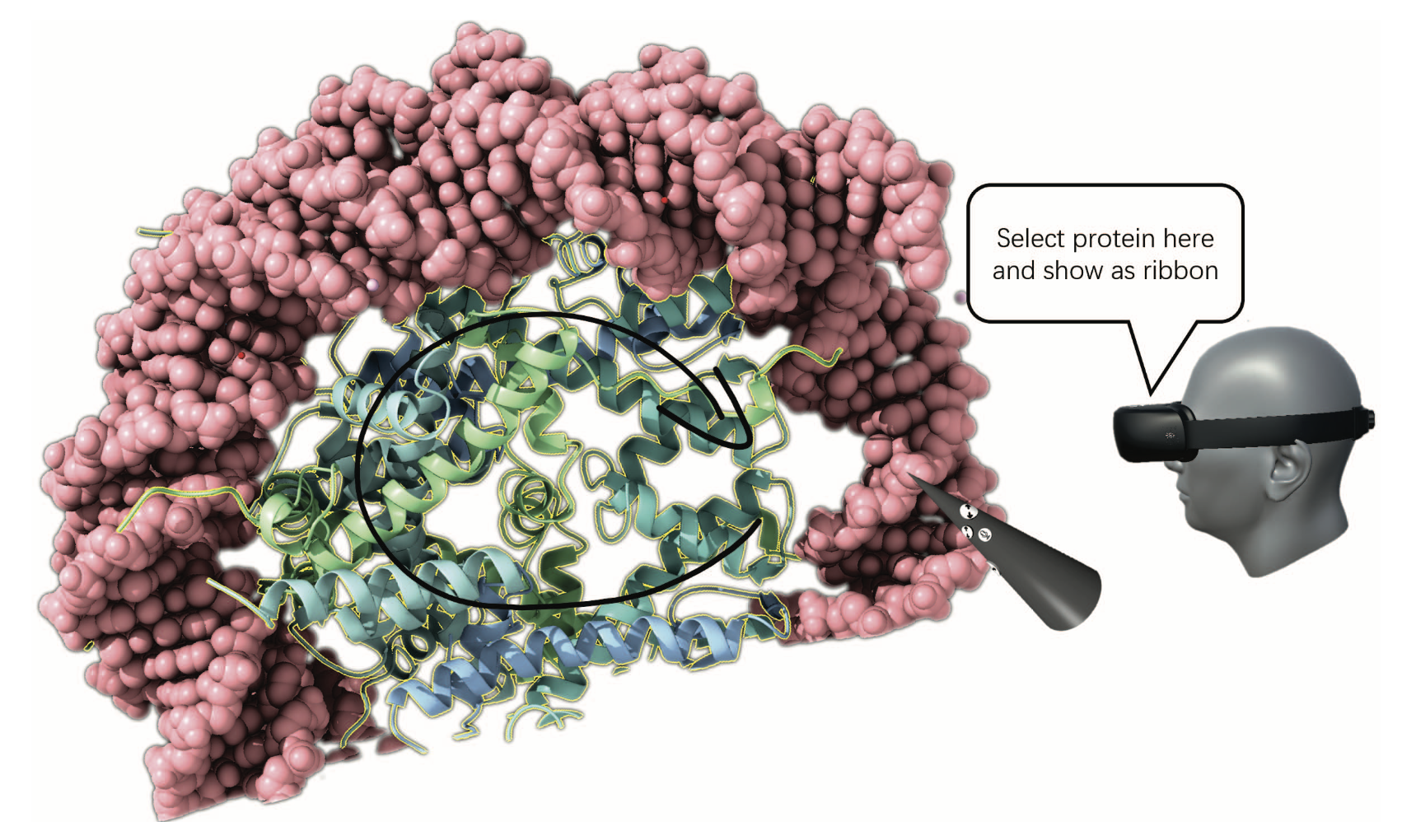
Some Limitations of VR Hand Controllers
- switching modes (rotation, translation, selection, etc.) is unintuitive
and has a high learning curve:
- if the different modes are accessed with different controller buttons,
the user has to learn/remember which button does what
- “accidents” happen when one forgets which mode is active
or uses the wrong button
- 2D interfaces for mode switching (e.g., icon bar or menu) are not generally recommended in immersive environments; issues include size of the display and occlusion of the scene
- if the different modes are accessed with different controller buttons,
the user has to learn/remember which button does what
- in the immersive environment, precise specification/selection in 3D is more difficult than one might think: judging depth, dealing with occlusion, etc., particularly if the structure is not yet well understood
Natural User Interfaces, Natural Language Interfaces
Existing NLIs for visualization were developed for/in desktop environments. These include:
- Articulate – machine learning-assisted, parses queries into commands
- DataTone – keyboard or voice input, keeps track of user corrections
- Eviza – users can iteratively modify queries
MEinVR builds upon these existing methods for a VR environment, with design goals to:
- minimize user learning costs and cognitive load
- reduce the accuracy requirements of each type of input
- play to the strengths and avoid the weaknesses of each type of input
- voice commands can refer to hidden or occluded parts
- pointing naturally conveys positions that are hard to describe in words alone
- controller movements naturally convey approximate distances and angles
Questions:
- How best to combine controller and speech input?
- Can the combination be used for complex tasks?
- Is the combination more effective than either type of input alone?
Implementation
Oculus Quest 2 using ChimeraX VR + speech recognition

- headset microphone captures audio
- Google speech-to-text (STT) converts the audio to text
- the system tries to recognize compound queries and split them accordingly
- Word2vec converts the text to a word vector for comparison with a library of existing commands
- Spacy calculates cosine similarity and returns the most similar command
- in parallel, VR controller in “query mode” tracks real-time position
Interface and Simple Task Examples
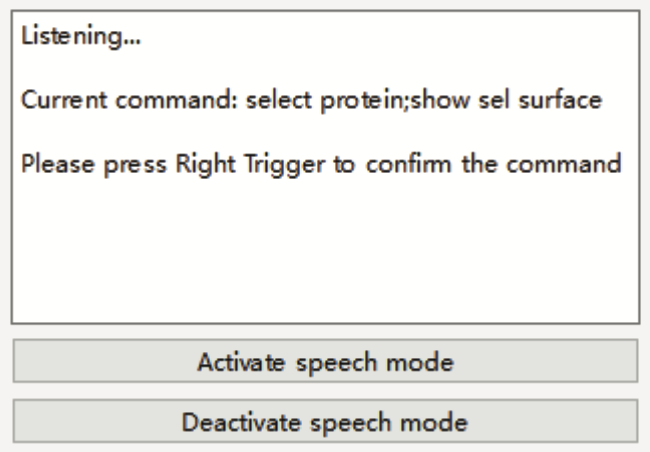
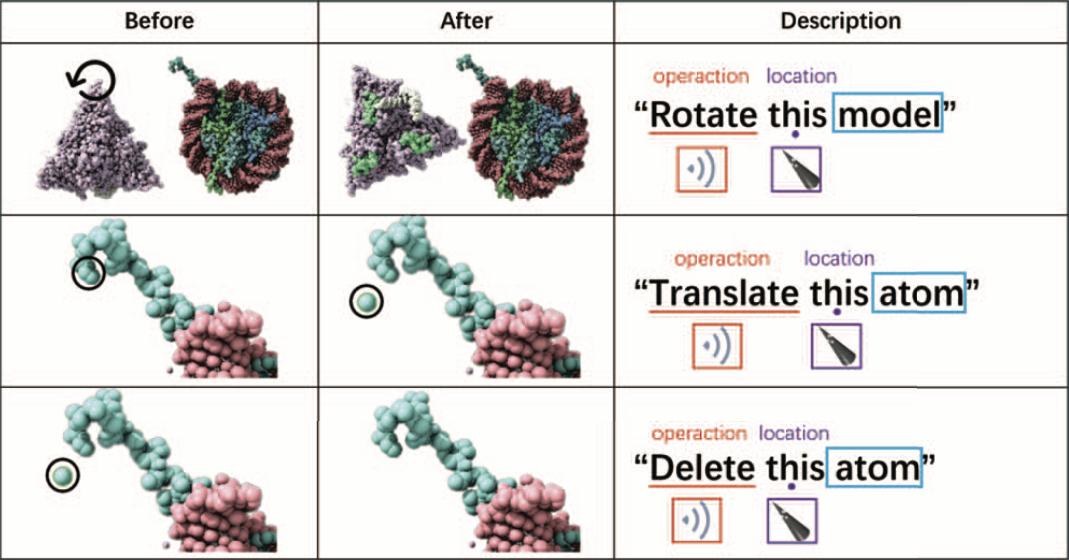
- would it work to say “this chain” or “this residue”?
- how do atomspec strings relate to their library of commands? (the lefthand figure only shows a generic category, “protein”)
- does controller position-tracking automatically get the atomspec? (like our desktop mouse atomspec balloons)
Complex Task Examples
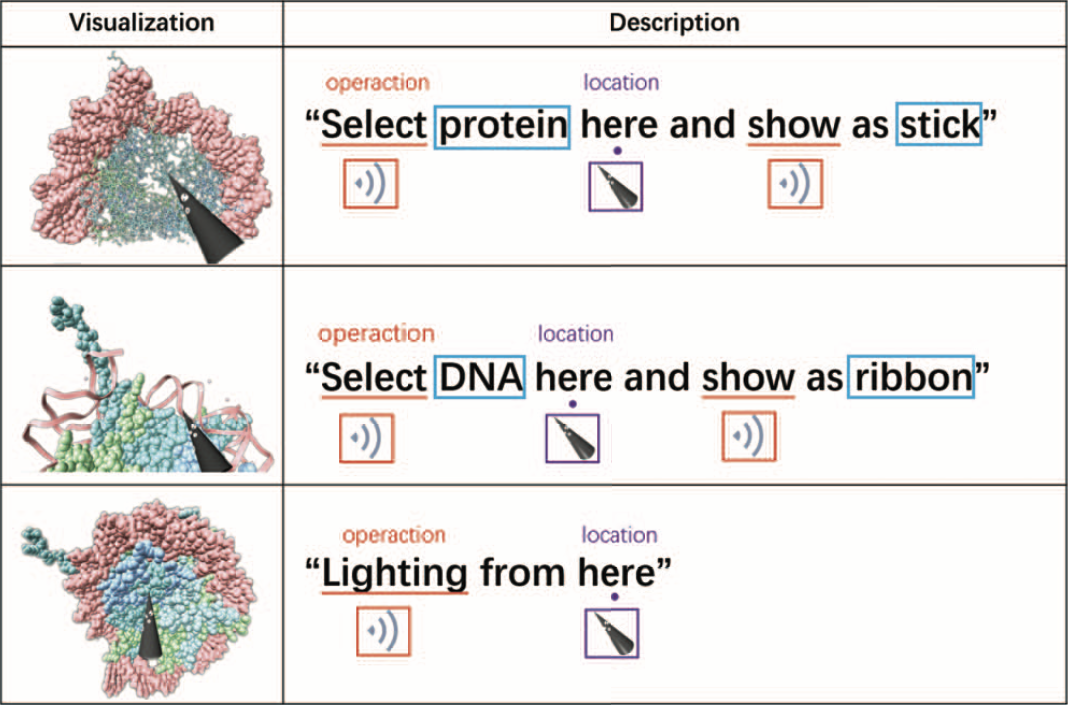
- if the target (e.g. protein) is not in the circumscribed region, nothing will happen
- does “this protein” expand to a single chain, or all protein in that model, or all protein in all models? (if the latter, the “this” is useless)
- the first two might be better without selection, e.g.,
“Show this protein as stick”
- ...however, their implementation probably requires a separate “select” action (cannot generate an atomspec for the “show” action)
Questions Redux
- How best to combine controller and speech input?
- the jury is out; the authors refer to the current approach as a prototype, but seem pleased with their initial progress
- Can the combination be used for complex tasks?
- some compound tasks are given as examples, but complexity may still be limited
- Is the combination more effective than either type of input alone?
- probably yes for novice users and the queries that their system can handle, but there may be many queries their system cannot handle
The authors basically punt by saying:
“Further studies are required to explore the prominent advantages of
each interaction input in different exploration tasks for various data.
Moreover, a comprehensive user study needs to be conducted to evaluate
the usability and effectiveness of our method in data exploration.”
I also didn't see anything about availability of their code, but the corresponding author's email address is given.